Proposing new enterprise training verification flow for McDonalds Limerick
Simplified verification process for crew trainers in McDonald's restaurants, training software FRED and projected to reduce verification time by 50% and save 150 min/per month per crew trainer.
Enterprise UX
Web App
UX Design

PROJECTED IMPACT
-50%
Trainer verification time
PROJECTED IMPACT
~150 mins
Saved/per crew trainer/month
PROJECTED IMPACT
0
Duplicate data entry
Background
Every time a crew trainer at McDonald's verifies a trainee, they leave the floor. They switch accounts, re-enter details the system already knows, and repeat the same steps twice. In a busy restaurant, that adds up to hours of lost floor coverage. FRED ( Online training verification software) was supposed to make training easier. Instead, it was quietly pulling staff away from the work that actually mattered.
My role
Crew Trainer, End-to-end UX (Research, UX design , UI design, Testing)
Environment
Shared in-store devices (5 per store)
Timeline
4 weeks
Three things slowing trainers down
Account switching
FRED’s verification workflow forces trainers to complete the same steps in two separate accounts, once in crew trainer's account and once in trainee's account.
Manual data entry
Manual search for trainees and stations, and re-entering information that’s already known by the system.
Delay in verification
It takes around ~12 to ~15 min for a crew trainer to verify a trainee on a station and a crew trainer verify around 3-5 stations every session. This leads to crew trainer and trainee leaving the floor for hours, resulting in an understaffed floor.
~15 min
per verification / per station, not per session
3–5×
stations verified per session, meaning trainers and trainees could be off the floor for hours
Research & Discovery
I observed before designing.
Watched trainers use FRED during real service conditions with no assumptions or secondhand descriptions.
Spoke directly with trainers
Gathered firsthand accounts of friction points and how the tool was affecting their daily workflow.
What I found
Trainers are switching between multiple accounts to complete one verification.
Duplicate submissions are confusing the system no single source of truth.
Wasted time during busy service periods.
Understanding What Actually Mattered
INPUT
Manager interview
Asked what data was genuinely required for a valid verification
PROCESS
Separated signal from noise
Identified what the system collected vs. what compliance actually needed
OUTPUT
Prioritised information hierarchy
Reduced fields to only what mattered which leads to less cognitive load, same business value
KEY INSIGHT
The problem wasn't just duplication, it was that nobody had defined what a verification actually needed to contain. That clarity unlocked the redesign.
Design Decisions
Kept existing visual language for UI
FRED doesn't exist in isolation. It is one of the modules within McDonald's broader employee software ecosystem. Introducing a new visual language would risk inconsistency across connected systems and create retraining overhead for staff who move between modules daily.
Single trainer-led flow
Eliminated account switching entirely which is the root cause of duplication, not just a symptom of it.
Automated repetitive data entry
Pre-filled trainee name, trainer name, feedback, scoring, and station suggestions removing the manual steps that slowed trainers down on every single verification.
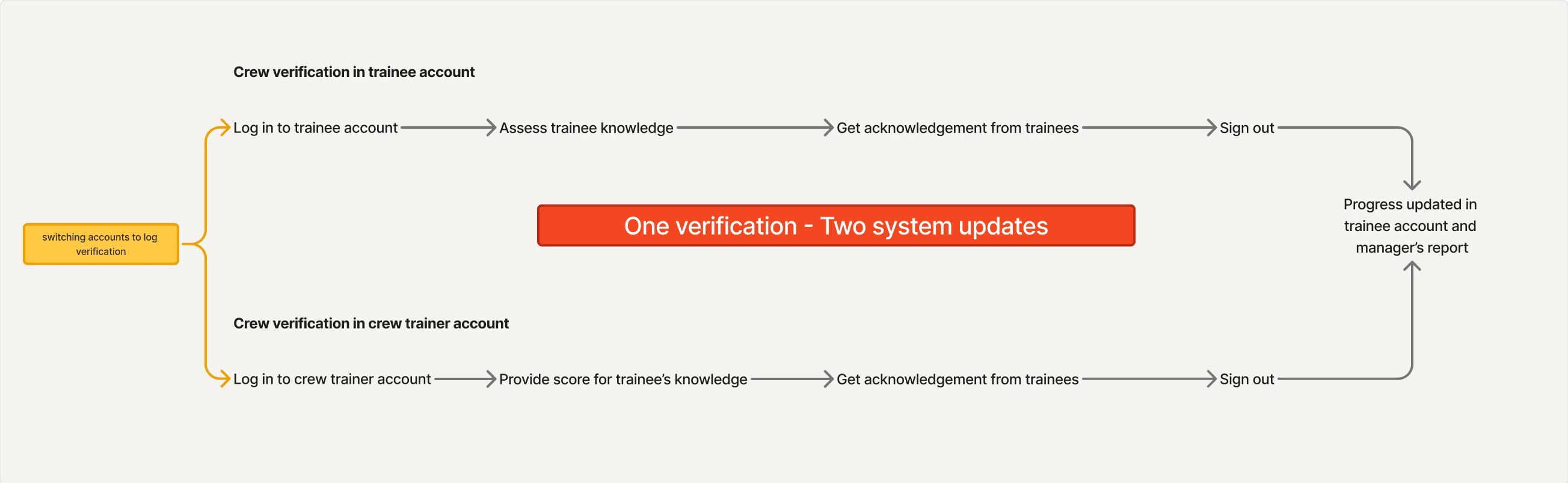
current verification flow - duplicate submission
This double-entry structure wastes time, shared device dependencies, creates reporting gaps, and pulls staff off the floor during peak hours.
No structured scoring and feedback
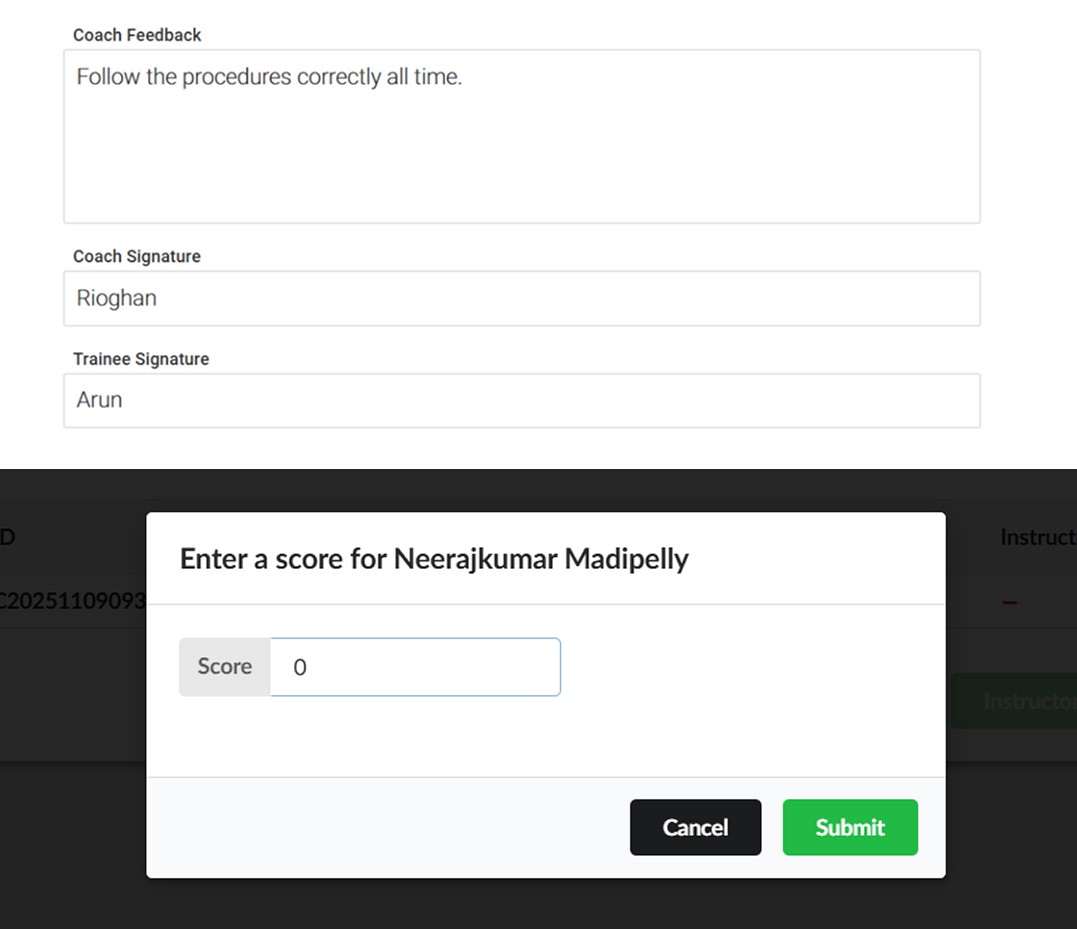
Managers expect trainers to give full marks, but the current scoring input is pointless and slows completion. Unnecessary for what is essentially a compliance checkbox, but the current system requires more typing, more time wasted.
Filling repetitive details causing delay
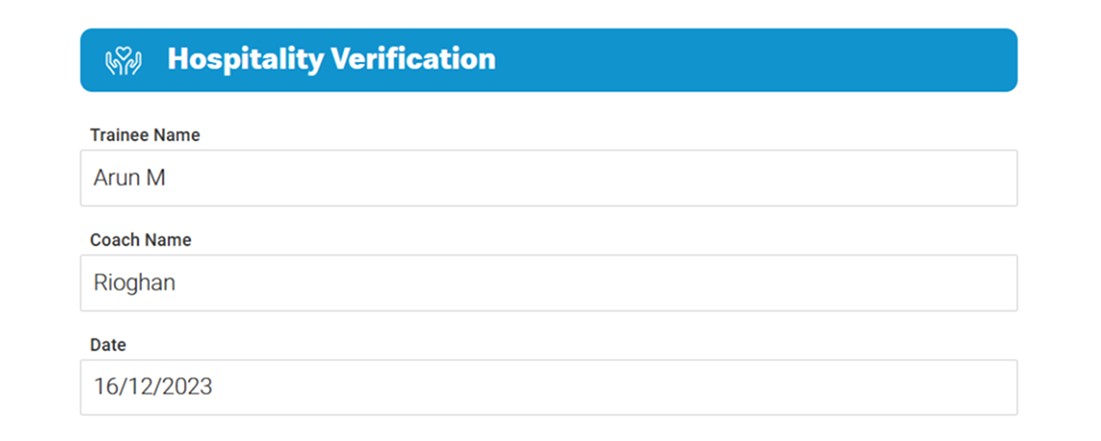
Crew trainers are expected to fill in details like Trainee name, coach name, and dates multiple times every time they verify trainees for every station.
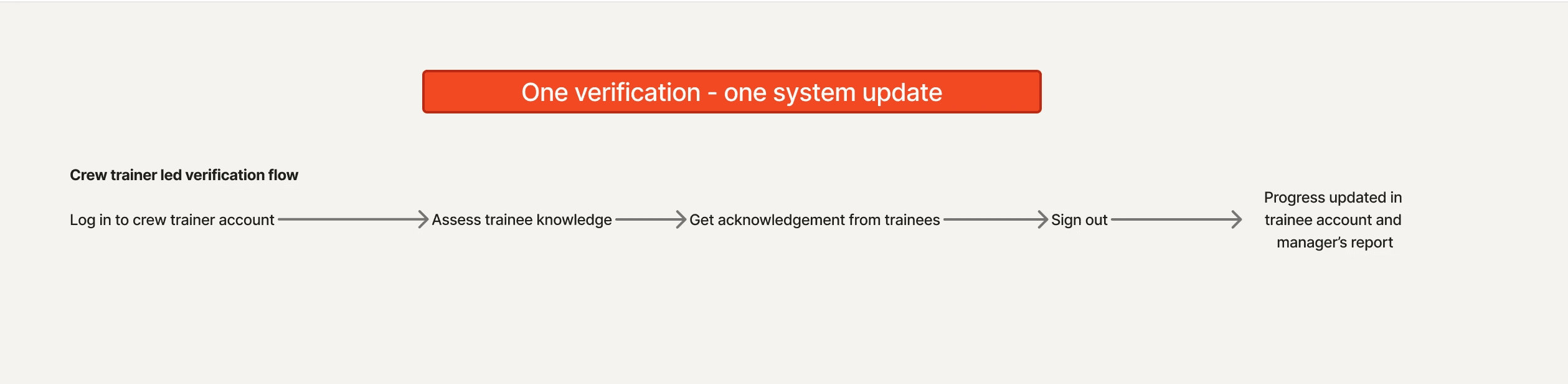
Proposed Flow — One Verification, One Update, Zero Duplication
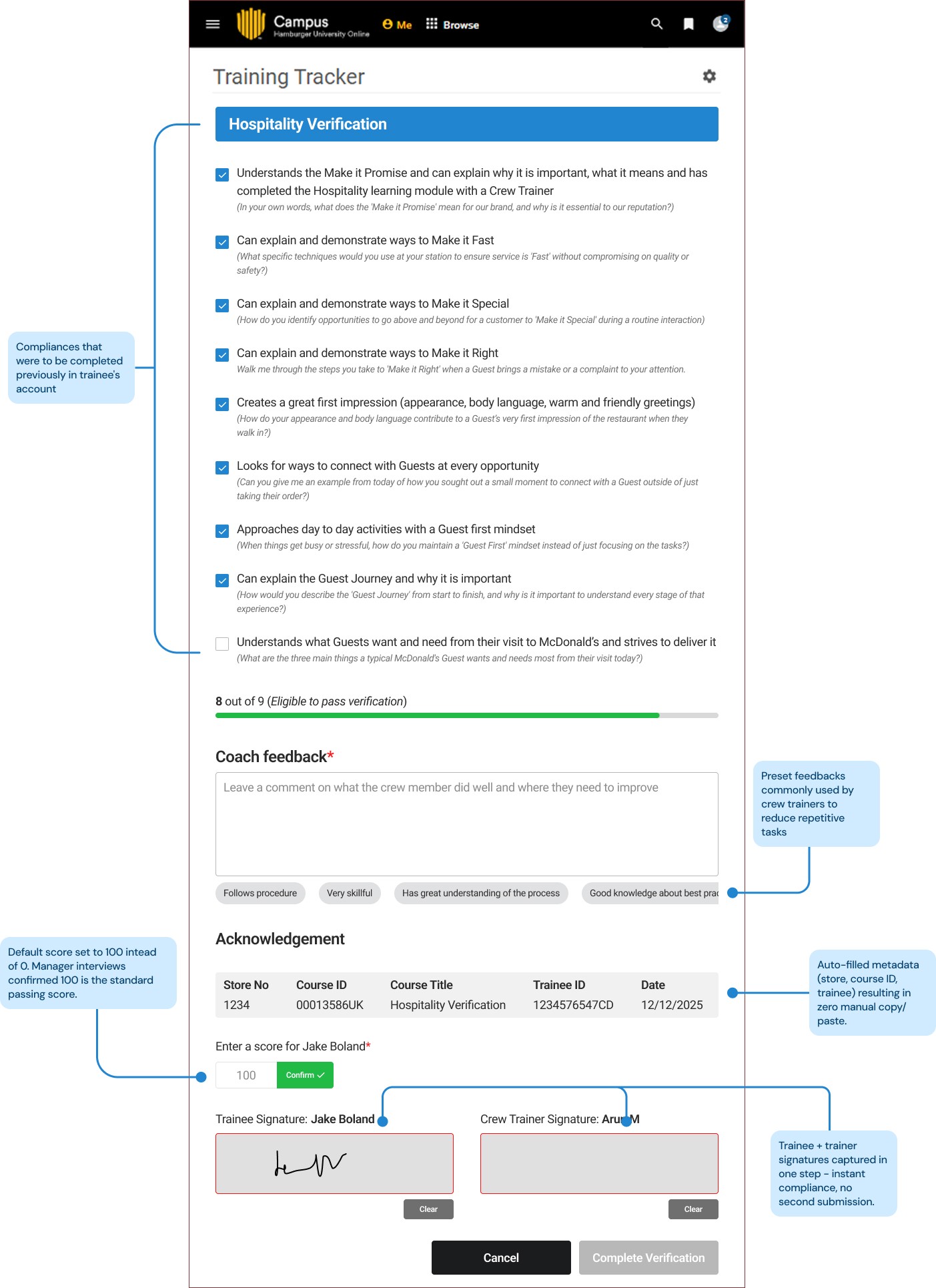
Verification now happens once, in the crew trainer's account.This eliminates cross-account navigation and duplicate data entry, cutting verification time by ~50–60% in busy store environments.
In the new flow:
FRED auto-pulls trainee details (no manual data entry)
Suggested stations based on training history
Checklist completion meets compliance in seconds
Signatures finalize the record in one submission
"The goal wasn’t to improve training quality inside FRED. Training happens on the floor. My goal was to make FRED stop getting in the way"
Updated design
FRED is not a standalone platform. It is part of the McDonald's employee software ecosystem. The interface was adapted to support the consolidated workflow. No new navigation model or permissions system was introduced. The UI simply reduced friction to match real-world behaviour on the floor.
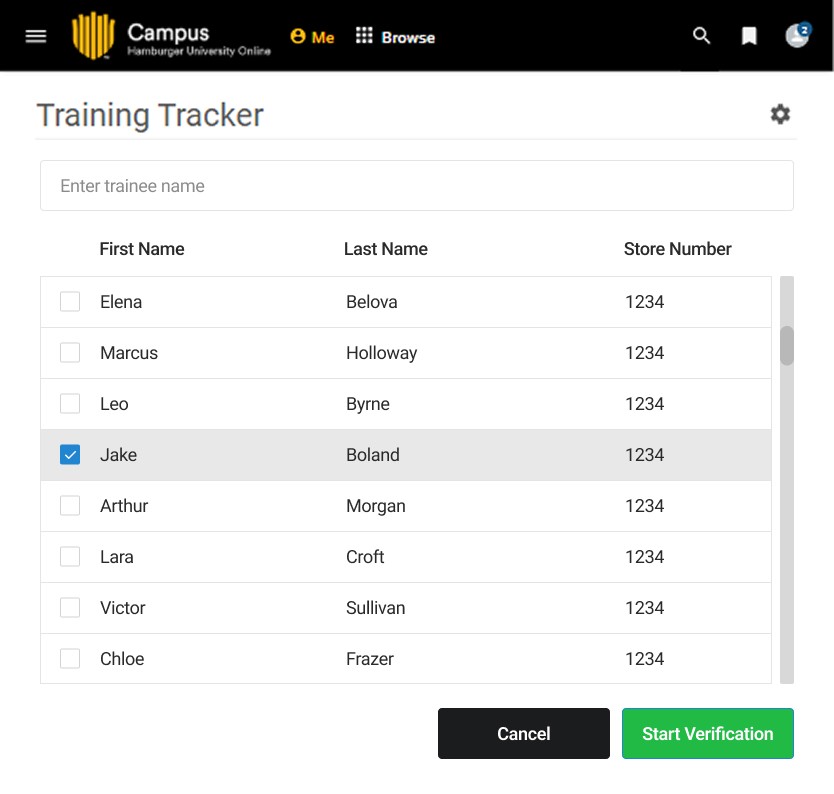
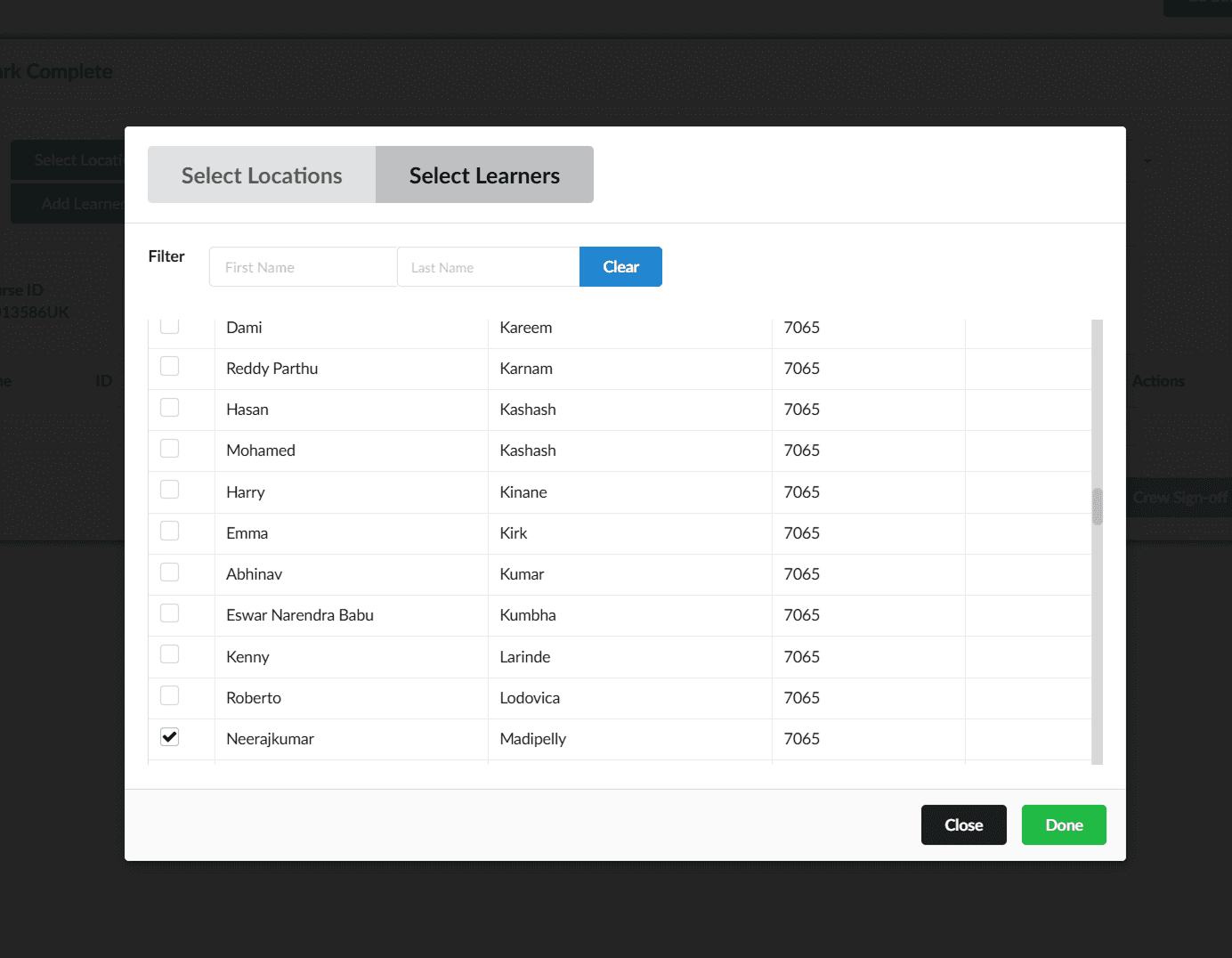
Verification starts with the trainee, not the station
Existing workflow starts with choosing stations and selecting the trainees after which does not match how verification works in real life.
The buttons are designed to be intentional with contextual labels. I also removed unimpactful filters to reduce cognitive load and visual clutter.
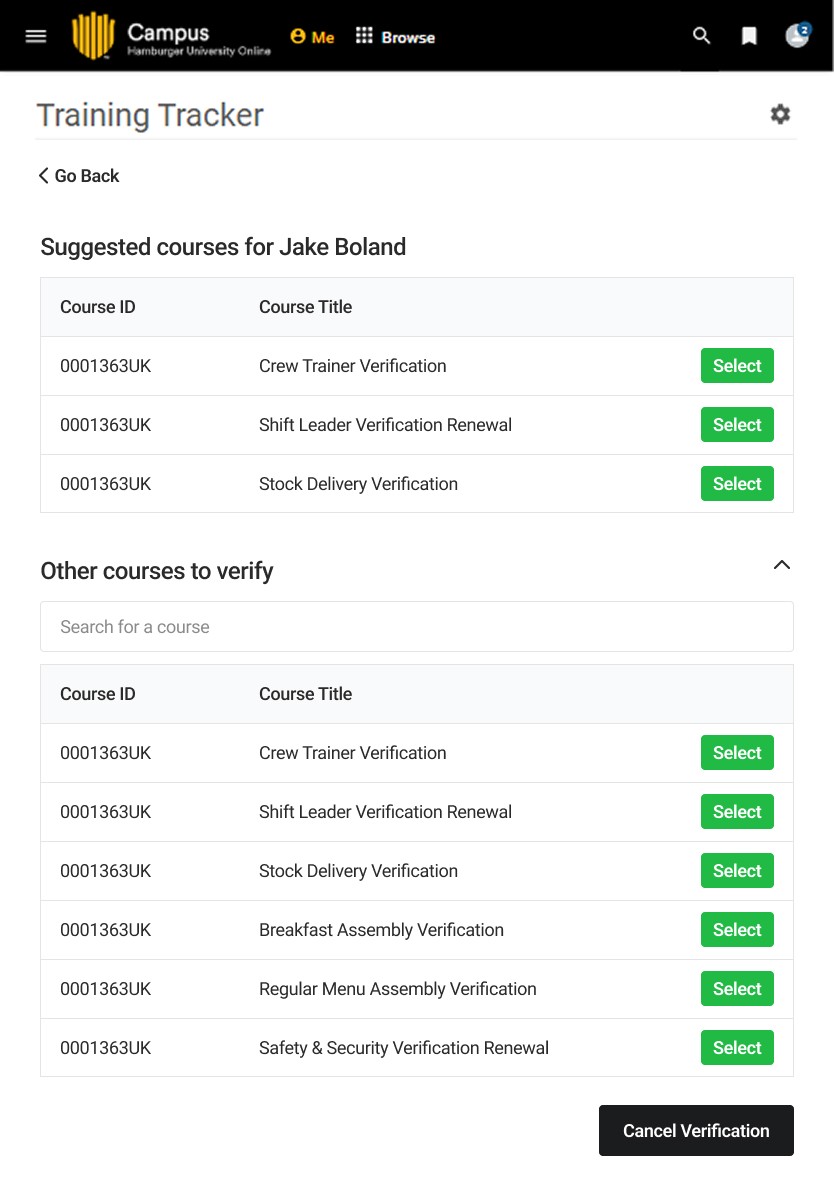
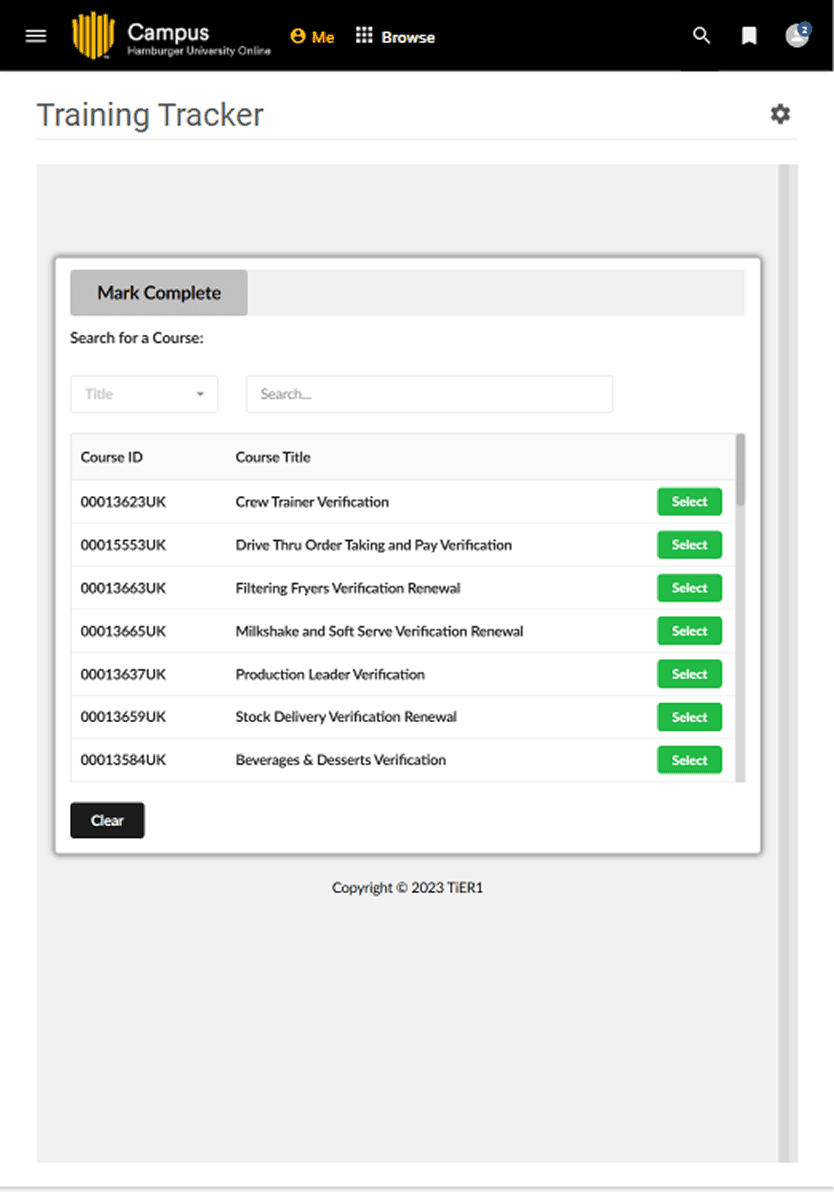
Suggested station based on trainee training history
Introduced a smart automated suggestion to reduce manual efforts in finding stations.
This enabled the crew trainers to choose, instead of finding stations, to verify and to be flexible in finding stations if needed.
All verification now happens in the Crew Trainer account — eliminating role switching, duplicate entries, and cross-account updates.
This removed the second verification step entirely and cut average completion time from ~6 minutes → ~3 minutes per trainee.
Testing and projected impact
I tested this prototype with 6 crew trainers in store during their break hours in shifts and asked them to perform their usual verification routine and walk through by saying their thoughts out loud. We achieved the following projected impact.
This redesign doesn’t reduce screens; it removes work.
Eliminating manual data entry and duplicate submission cuts verification time,errors drop to near-zero, and the flow finally matches the reality of floor training.
↓50%
Average completion time per evaluation will be reduced from ~15 to ~5-7 minutes
150+ Min
A store with 25 trainees completing 2 courses/month saves 150+ minutes/month (~ 2.5 hrs) of trainer time
KEY IMPACT
After presenting the redesign in-store, managers responded immediately. The solution was escalated to a regional manager for further discussion on implementation. But I later found out from the regional manager that they have been making changes to the training system already and should be introducing soon.
Key Learnings
WHAT THIS TAUGHT ME
The biggest impact came from subtraction. Removing a step and not adding a feature which solved the problem. Complexity in enterprise tools builds up quietly over time.
What I'd do differently
Push to measure real post-launch data. The 50% reduction is a projection I believe in, but live usage would either confirm it or surface the next problem worth solving.