Make new recipes with what you own with an ingredient-first approach to cooking and a novelty engine to stop making repeated meals.
You already know how to cook. You just keep making the same things. Mise shows you what else is possible with what you already own with an ingredient-first approach with a novelty engine.
Mobile App Desgin
AI Assisted Workflow
System Thinking
End-to-End Design
PostHog Analytics
My role
Product Designer
Tools
Loveable, Gemini, Figma, Claude, Perplexity
Timeline
April - May 2026


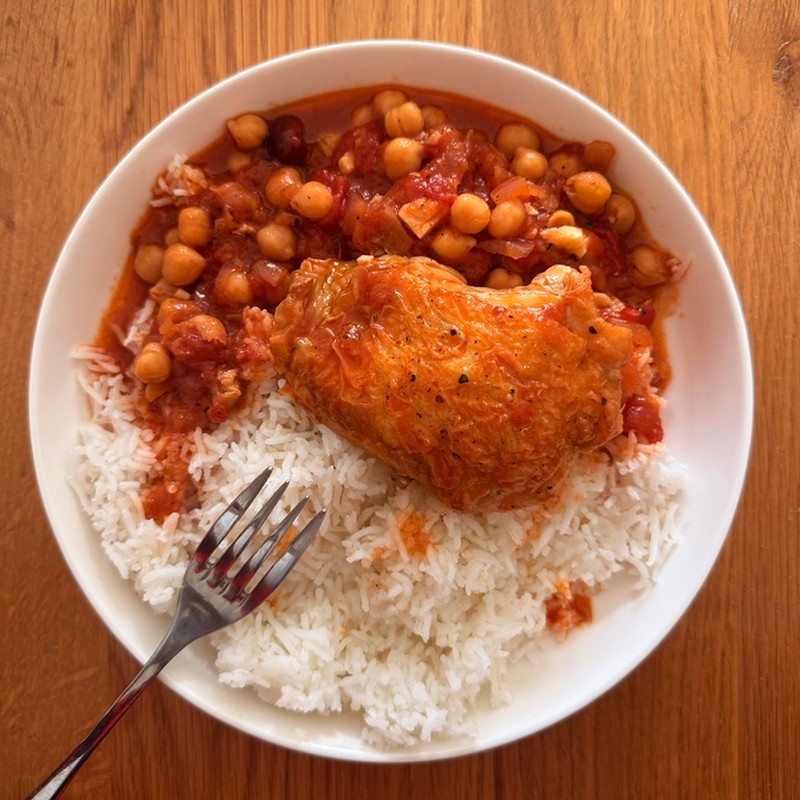
I was making the same 5 meals on rotation. Not because I couldn't cook. Because by 6pm, after work, the idea of deciding what to make felt harder than the cooking itself.
They actively wanted to try new dishes. But every attempt meant the same exhausting sequence: find a recipe → identify missing ingredients → plan a shop → buy them → cook.
MY HYPOTHESIS
People do not avoid new recipes because they lack interest; they avoid them because planning a new dish often means extra shopping, ingredient checks, and missing-item gaps that make cooking feel harder than repeating familiar meals.
Basil & Salt Magazine
70%
Stuck in a rut and bored with the same meals
QSR Magazine
84%
Want to try new dishes but can't because of time and effort
SuperValu Survey
34%
Find deciding what recipes to make hard
My hypothesis is partially validated
Secondary research partially validates the hypothesis that people get stuck in a rut, want to try new meals but I had no evidence that planning shopping is a reason why peolpe don't make new meals.
What if the user could
Spend less time choosing recipe and actually start making them
Control how much effort they can afford to make that meal
Analysing similar apps
| App | Ingredient‑first | Novelty engine | Cook mode | Target moment |
|---|---|---|---|---|
| Ingredient-first apps | ||||
| SuperCookTurn available ingredients into recipes | Any time you want to cook with what you have | |||
| Frigo MagicCreate recipes from fridge/pantry ingredients | Any time, especially when you have leftovers | |||
| KitchenPalPantry tracking and food waste reduction | Pantry cleanup / food waste prevention | |||
| Apps with cook mode | ||||
| PaprikaRecipe organization and planned cooking | Planned cooking | |||
| Samsung FoodMeal planning and guided cooking | Planned cooking | |||
| Recipe discovery apps | ||||
| YummlyRecipe discovery and recommendations | Recipe browsing / inspiration | |||
| TastyRecipe discovery and short-form cooking content | Recipe browsing / inspiration | |||
| AllrecipesLarge recipe discovery library | Recipe browsing / inspiration | |||
| MiseIngredient-first + novelty engine + cook mode | Late-afternoon dinner decision / “what do I cook now?” moment | |||
Three ways people decide what to cook
Ingredient-first
"What do I have? What can I make from it?"
Recipe-first
"I want to make X. What do I need to buy?"
Constraint-Based
"I need to cook something in 30 mins."
Gap and opportunity identified
Every major app serves recipe-first and mood-first. No app combined ingredient-first, a novelty engine, and a native cook mode.
Design decisions
Pantry stables arrive preselected. Deselecting is faster than building from scratch.
Meals are anchored to protein. So the recipe engine weights it highest. Recipes are scored and not filtered.
No protein → Vegetables take priority
Two proteins → Recipes using both scored first depends on type of the proteins
One instruction per screen. Large type. Built-in timers. Voice commands. Wet hands on a screen is friction the app shouldn't create.
Unmoderated - High intent users (Friends, Family, colleagues)
14
Users tested
11
Cooked end-to-end
3
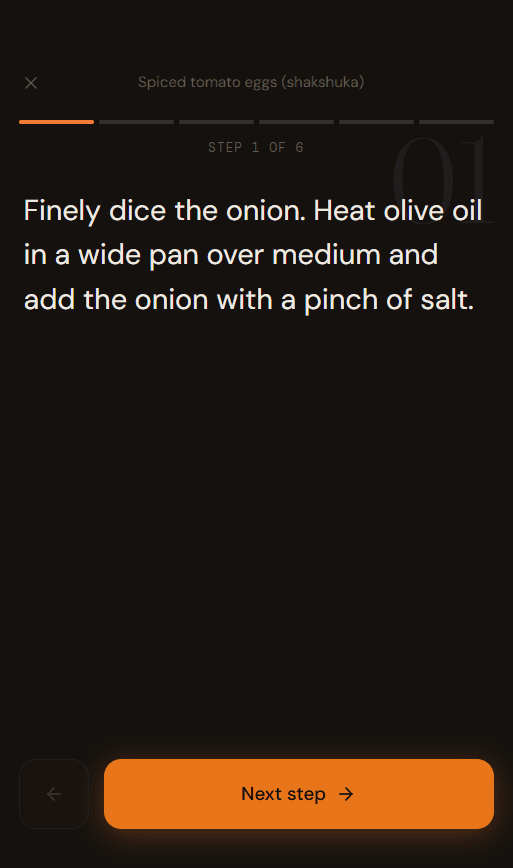
Walkthrough
"Finely dice the onion" did not work for user who has never made the recipe before. Switched to precise metric quantities throughout.
→

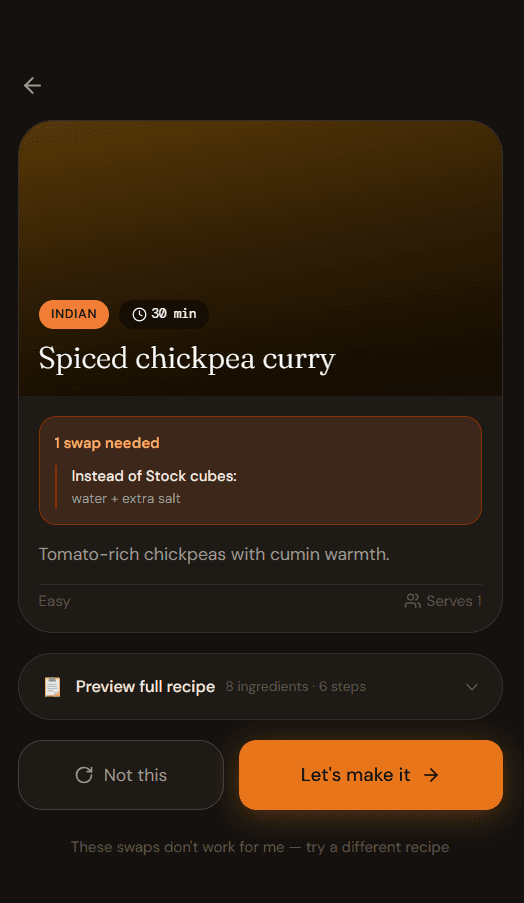
Added a full preview involving ingredients, steps, time before cooking mode begins.
System now tells you if it's critical or substitutable. Non-critical ? suggests a swap. Critical? offers a different recipe.
Users had ingredients not in the defaults. Free-text input added to every screen after testing.

→
11/14
users successfully cooked a recipe they have never made before with what they had in their kitchen
"I never made fried rice before and family loved it"
Courtney (Cooks 3-5 times a week)
"I got missing ingredient and I still made recipe I never would have thought"
Tom (Lives alone in Vienna and had to cook out of necessity)
"I got this new golden chicken recipe I have never made before. Excited to try it now"
Ciara (Cooks 3-5 times a week)
New research revelation
Even though Mise enables users to cook new meals, it only addresses one of three reasons people default to familiar meals, reduced mental effort. The other two causes like perceived risk and ease of maintenance remain unsolved.
Why users get stuck on repeated meals
Reduced mental effort
People do not have to plan, compare, or think as much each time they eat
Feel safe and predictable
Repeating known meals lowers uncertainty, which makes food feel more comfortable and less risky.
Easier to maintain
Familiar meals fit routines, schedules, budgets, and energy levels
Next step
HMW reduce the perceived risk of cooking an unfamiliar recipe so users feel confident committing to something new?
I designed a "WHY THIS DISH" feature to reduce uncertainity
A familiar recipe carries information you already have; you know it's easy, you know how it tastes. An unfamiliar one strips that away, right at the moment you're deciding whether to commit. The 'why this dish' layer replaces that missing intuition with
An effort score computed from observable factors (steps, pans, active time)
A taste description anchored to ingredients you own and a generated recipe
Most importantly why the system suggest this recipe

Unmoderated - Low intent users (Reddit and other internet communities)
125
Real visited users
28
Users generated recipes
10
Users cooked with it
70% of visitors never generate a recipe at all
CAUSE
From session recordings and insight summary from PostHog, users skip the inventory set up and reach recipe generation to get a "empty kitchen" error and leave
The inventory set-up currently leads with protein (an important ingredient) to increase chances of recipe generation even if they skip other ingredients.

I am exploring ways to entice users to set up inventory first. I am doing it through changing the input interactions from a 6 step inventory selection to a voice dump

I confirmed that deciding what to cook was hard, formed a hypothesis around it, and built against it before asking what else might be causing the same behaviour. Broader research afterward surfaced two more reasons people stay in rotation. Starting with wider exploratory research would have given me a more complete picture before committing to a direction.
A user adding a vegetable to the protein screen is predictable, not exceptional. I mapped these scenarios early and planned prediction, snackbar confirmation, category reassignment. Forgiving without being silent.
The prep screen slows the flow. That's intentional. Skipping it means interruptions mid-cook, lost timers, and broken steps. The cost of stopping once the heat is on outweighs the cost of one extra screen. It stayed.
When users visit the app, the system remembers their kitchen. This eliminates the need for users to set up a kitchen in every session unless they want to modify inventory. But it increases the chance of the system generating wrong recipes if users assume they have certain ingredients and go ahead into cook mode with missing ingredients.